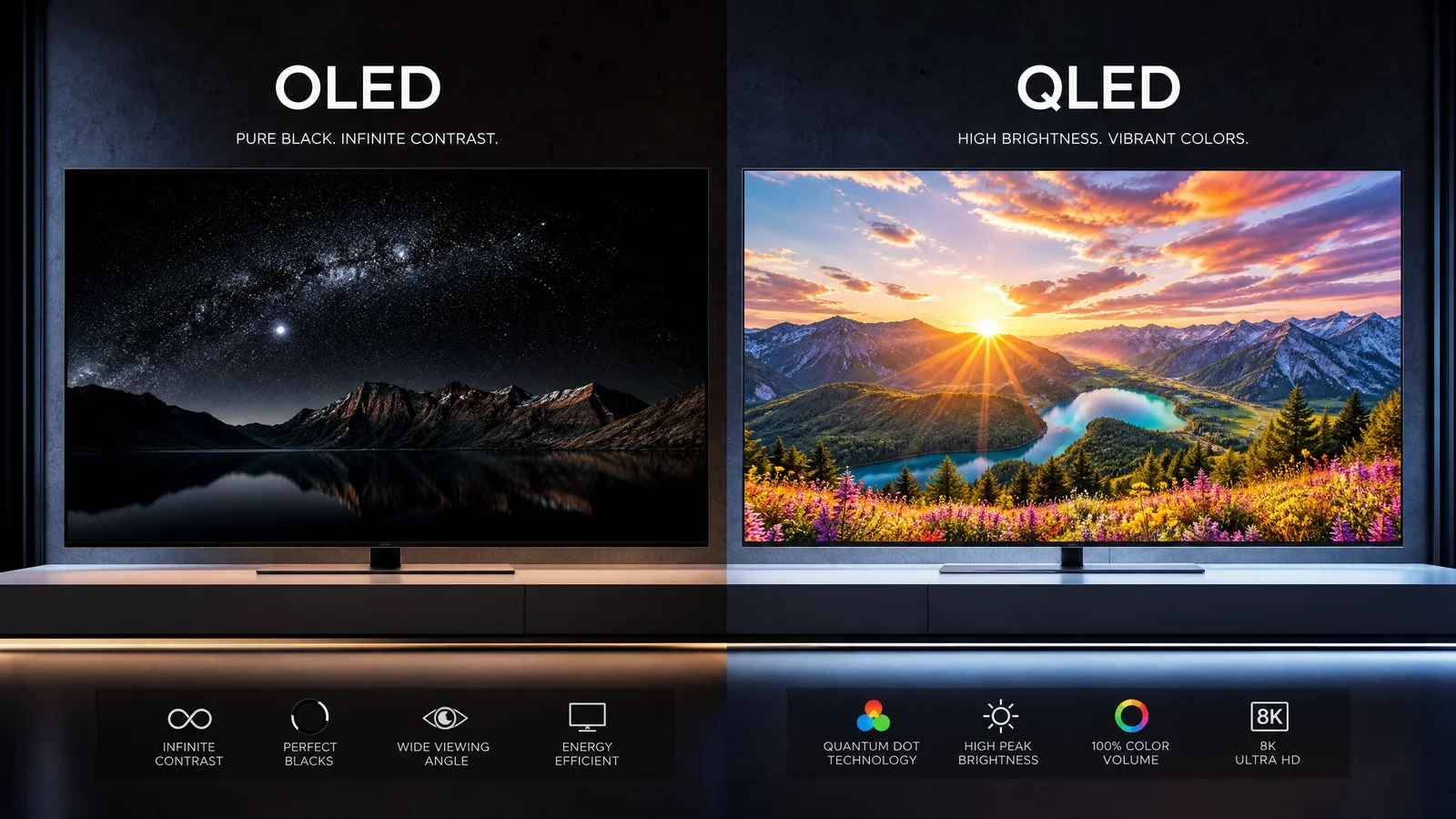
OLED and QLED describe different parts of a television’s design. OLED uses self-emissive pixels that can turn off individually, while QLED is generally an LCD TV that uses a quantum-dot layer to improve color performance, usually alongside an LED backlight. The best choice depends on room lighting, viewing habits, gaming, size, and budget.
Contrast and black level
OLED’s pixels can produce very deep blacks without a separate backlight, which gives dark-room films strong contrast and precise shadow separation. QLED models rely on a backlight, so their black level and blooming behavior depend on the panel, local-dimming system, and processing. A well-designed Mini-LED QLED can still produce a powerful HDR image.
Brightness and room light
Many QLED LCDs are attractive for bright rooms because their backlights can deliver strong highlights and full-screen brightness. OLED can also look excellent in daylight, but the exact model and anti-reflection coating matter. Compare sustained brightness and reflections rather than relying only on the technology label.
Color and viewing angle
Quantum dots can help an LCD produce a wide color gamut, especially at high brightness. OLED offers consistent pixel control, but viewing angle, color shift, and panel behavior vary by model. Review the exact television from the seats where your household will watch it.
Gaming and motion
Gamers should check HDMI bandwidth, VRR, ALLM, supported resolutions, input latency, and burn-in guidance for the exact model. OLED’s pixel response can make motion look clean, while QLED may offer a different balance of brightness and long-session reassurance. Both categories include models with strong and weak gaming implementations.
Longevity and everyday use
OLED manufacturers include pixel-care features and guidance for static content. QLED does not use self-emissive organic pixels, but any display can develop faults or image retention under unusual conditions. Follow the manufacturer’s care instructions and consider the type of channels, games, and dashboards that remain on screen for long periods.
Which should you buy?
- Choose OLED for pixel-level blacks, dark-room cinema, and a clean response when the model’s brightness and care requirements suit you.
- Choose QLED for a bright room, strong sustained light output, broad size choice, or when the exact LCD model offers the better value.
- Compare the whole TV: contrast, reflections, motion, ports, software, sound, warranty, and return policy matter more than the badge alone.
Related Reading: What Is HDR? A Plain-English Guide to HDR TV