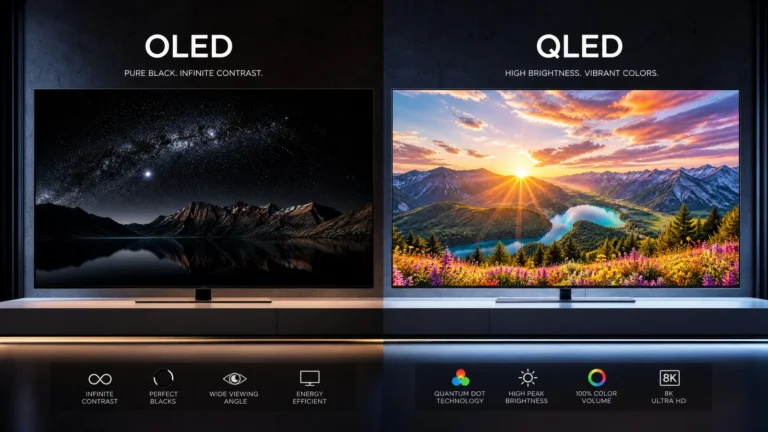
MicroLED and Mini-LED are not interchangeable terms. Mini-LED is an LCD television with a much denser LED backlight, while MicroLED uses microscopic self-emissive LEDs so individual pixels can produce their own light. The distinction affects contrast, brightness, size, price, and availability.
The backlight difference
A Mini-LED TV still has an LCD layer. Thousands of smaller backlight emitters can be grouped into local-dimming zones, allowing the TV to dim parts of the screen behind dark content while brightening other areas. MicroLED does not need an LCD layer or a conventional backlight: each pixel is independently emissive, more like an OLED in operation.
Contrast, blooming, and viewing quality
MicroLED’s pixel-level control can produce very deep blacks and extremely precise highlights without the halo around bright objects that LCD local dimming may create. Mini-LED can still deliver excellent HDR impact, especially in a bright room, but its result depends on zone count, diffuser design, processing, and the scene itself. Small bright objects against a black background are the most demanding test for blooming.
Brightness and room conditions
Mini-LED LCDs are often attractive for sunny rooms because the backlight can produce strong full-screen and highlight brightness. MicroLED also has high brightness potential, but real performance varies by product and calibration. Do not infer picture quality from the technology name alone; check independent measurements for the exact model when available.
Durability, size, and availability
MicroLED avoids OLED’s organic pixel material, but that does not make every MicroLED product automatically better or easier to own. Large modular designs, manufacturing complexity, and limited retail availability have historically made MicroLED far less accessible. Mini-LED is available in many more screen sizes and price tiers, making it the practical choice for most buyers.
Which technology should you choose?
- Choose Mini-LED if you want strong HDR in a bright room, a wide range of sizes, and a technology that is easier to find and compare.
- Consider MicroLED only if the specific product fits your budget, installation, service, and size requirements, and you value pixel-level control above availability.
- Compare the whole TV: peak and sustained brightness, black level, blooming behavior, motion processing, gaming features, viewing angle, and warranty terms matter more than the label alone.
Practical conclusion
MicroLED is the more ambitious display architecture, but Mini-LED is usually the more realistic purchase. For most homes, a well-reviewed Mini-LED TV can provide an excellent balance of brightness, contrast, size, and cost. MicroLED becomes interesting when its installation and price are acceptable and the buyer specifically wants self-emissive pixel control.
Related Reading: What Is Local Dimming? LED Backlight Zones Explained