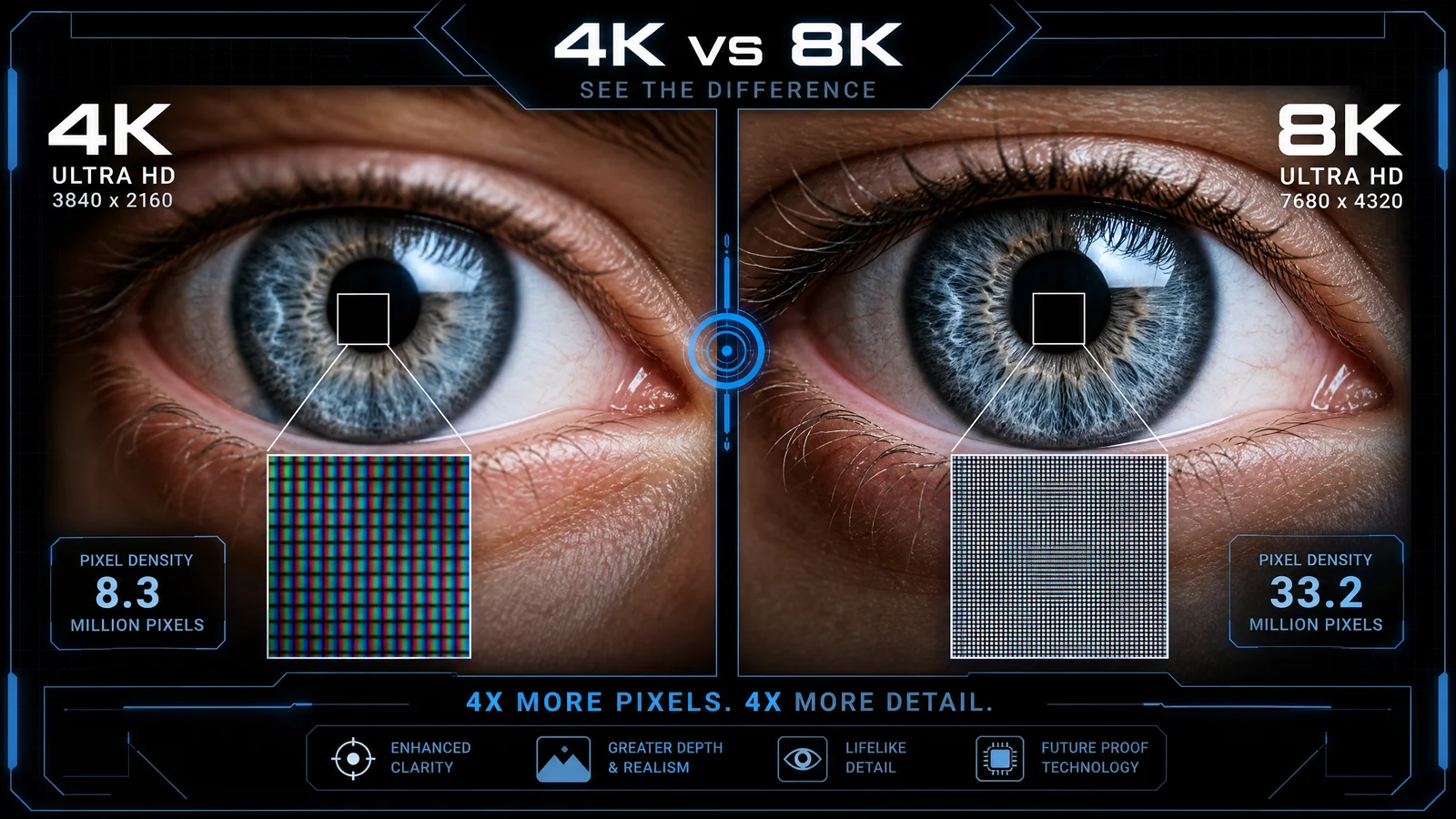
8K TVs offer four times as many pixels as 4K, but resolution alone does not determine whether an upgrade is worthwhile. The answer depends on screen size, viewing distance, native 8K content, upscaling quality, HDMI requirements, price, and how long you expect to keep the television.
The content problem
Most everyday streaming and broadcast content is still delivered below native 8K. An 8K TV therefore spends much of its time upscaling 4K or HD video. A good processor can make lower-resolution material look clean, but it cannot recreate every detail from a source that never contained it. Check the content you actually watch rather than buying for a theoretical library.
When extra resolution is easier to see
Resolution differences are easier to notice on a very large screen or from a relatively close seat. On a normal living-room setup, improvements in contrast, motion, HDR tone mapping, reflection handling, and uniformity may be more visible than the jump from 4K to 8K. Demonstration footage in a showroom can exaggerate the benefit.
Connections and gaming
Check the exact HDMI bandwidth, supported refresh rates, HDR formats, and gaming features. An 8K label does not guarantee 8K gaming, 4K at a high refresh rate, or the same capability on every HDMI input. PC and console compatibility depends on the source device, cable, settings, and title.
Longevity and value
Buying an 8K TV for future content is difficult to justify because future standards and app support are uncertain. A high-quality 4K TV may provide better value if it offers stronger contrast, better processing, or features you will use now. Consider the warranty, software support, energy use, and the cost of replacing connected equipment.
Who should consider 8K?
- Large-screen buyers who sit close enough to benefit from higher pixel density.
- Owners who regularly view high-quality 8K photos or compatible native footage.
- Buyers who have compared the exact model’s upscaling, HDR, gaming, and HDMI behavior.
For most viewers, 4K remains the practical default when the alternative 8K model sacrifices contrast, brightness, sound, or price. If you choose 8K, choose it for the whole television and your real viewing environment, not for the number on the box.
Related Reading: What Is HDR? A Plain-English Guide to HDR TV